
Introduction
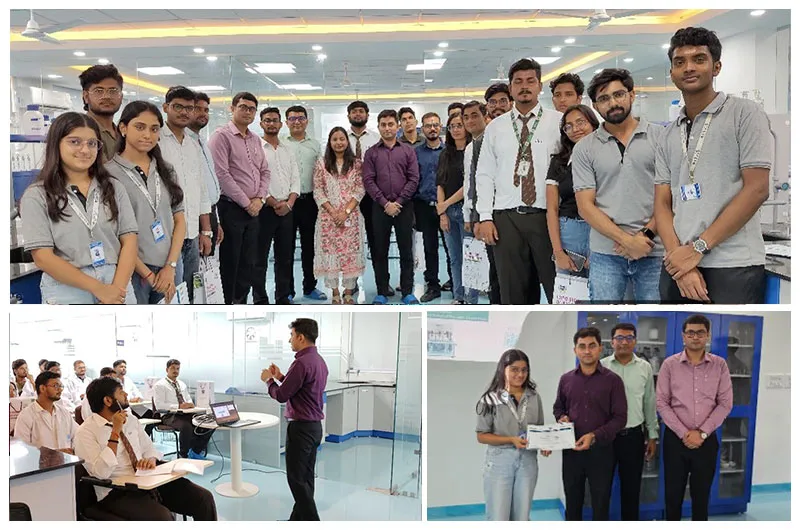
The Department of Pharmaceutics at Lloyd School of Pharmacy, Greater Noida organized a one-day workshop titled “Exploring Drug Release: A Practical Workshop on Dissolution Science” on 30th June 2025. The primary objective of the workshop was to bridge the gap between theoretical knowledge and practical skills in dissolution testing, a critical aspect of pharmaceutical formulation development and quality assurance.
The event witnessed enthusiastic participation from students of B. Pharm, M. Pharm programs, as well as research scholars from various institutions. The workshop was designed to provide comprehensive coverage of buffer preparation, serial dilution techniques, dissolution apparatus handling, and analysis of dissolution profiles using UV-Visible spectrophotometry.
Program Highlights
The workshop began at 11:00 AM with the registration of participants, followed by the serving of light breakfast and morning snacks to all attendees and invited guests.
The formal proceedings were initiated with an introduction speech by Mr. Rajeev Kumar, who welcomed the participants and dignitaries. In his address, he emphasized the significance of dissolution testing in the pharmaceutical industry and how such workshops contribute to building industry-ready competencies among students.
Following the inaugural address, Mr. Nishant Gaur, the Workshop Facilitator, delivered an engaging theory session. The lecture covered key concepts including:
- The principles of buffer preparation and its role in simulating biological conditions
- Serial dilution techniques and their application in preparing standard solutions
- The fundamentals of dissolution testing, selection of media, and setting of apparatus parameters such as pH, temperature, and RPM
After the theory session, participants moved to the laboratory for the hands-on practical component, led by Mr. Nishant Gaur. He provided live demonstrations of buffer preparation, dilution procedures, operation of dissolution testing apparatus, and sample collection techniques.
A special acknowledgment goes to Dr. Raghav Mishra and Dr. Priya Gupta, who provided invaluable support from the initial planning stages to the final execution of the workshop. Their contribution extended beyond technical assistance during the sessions — they were actively involved in managing and coordinating every step of the workshop, ensuring that all aspects were smoothly organized and efficiently executed. Their dedication was key to the success of the event.
The workshop also included interactive discussions where participants asked questions and shared observations about the experiments conducted. This exchange significantly enriched the learning experience.
The event concluded with a certificate distribution ceremony, where each participant received a certificate of participation as a mark of their commitment and involvement in the workshop. This was followed by a lunch session, which provided a relaxed environment for further interaction among participants, faculty, and guests.
Acknowledgment
We take this opportunity to express our sincere gratitude to Prof. Vandana Arora Sethi Ma’am, whose valuable guidance, motivation, and kind approval were instrumental in making this workshop a success. Her encouragement at every stage helped ensure the smooth execution of the program.
We are equally thankful to our faculty colleagues, supporting staff, and volunteers whose dedication and teamwork contributed to the effective organization of the workshop. A special thanks to all the participants for their active involvement and for making the event truly interactive and insightful.
Conclusion
The “Exploring Drug Release: A Practical Workshop on Dissolution Science” workshop successfully met its objective of enhancing the technical capabilities of pharmacy students in dissolution testing. The combination of theoretical instruction and practical exposure helped participants gain a deeper understanding of the subject.
The positive feedback received from participants encourages the department to plan more such initiatives in the future to further strengthen the practical training component of our academic programs.